ZakatEasy
A live calculator that works out what someone owes in zakat across ten asset and liability types — then explains the reasoning behind every number.
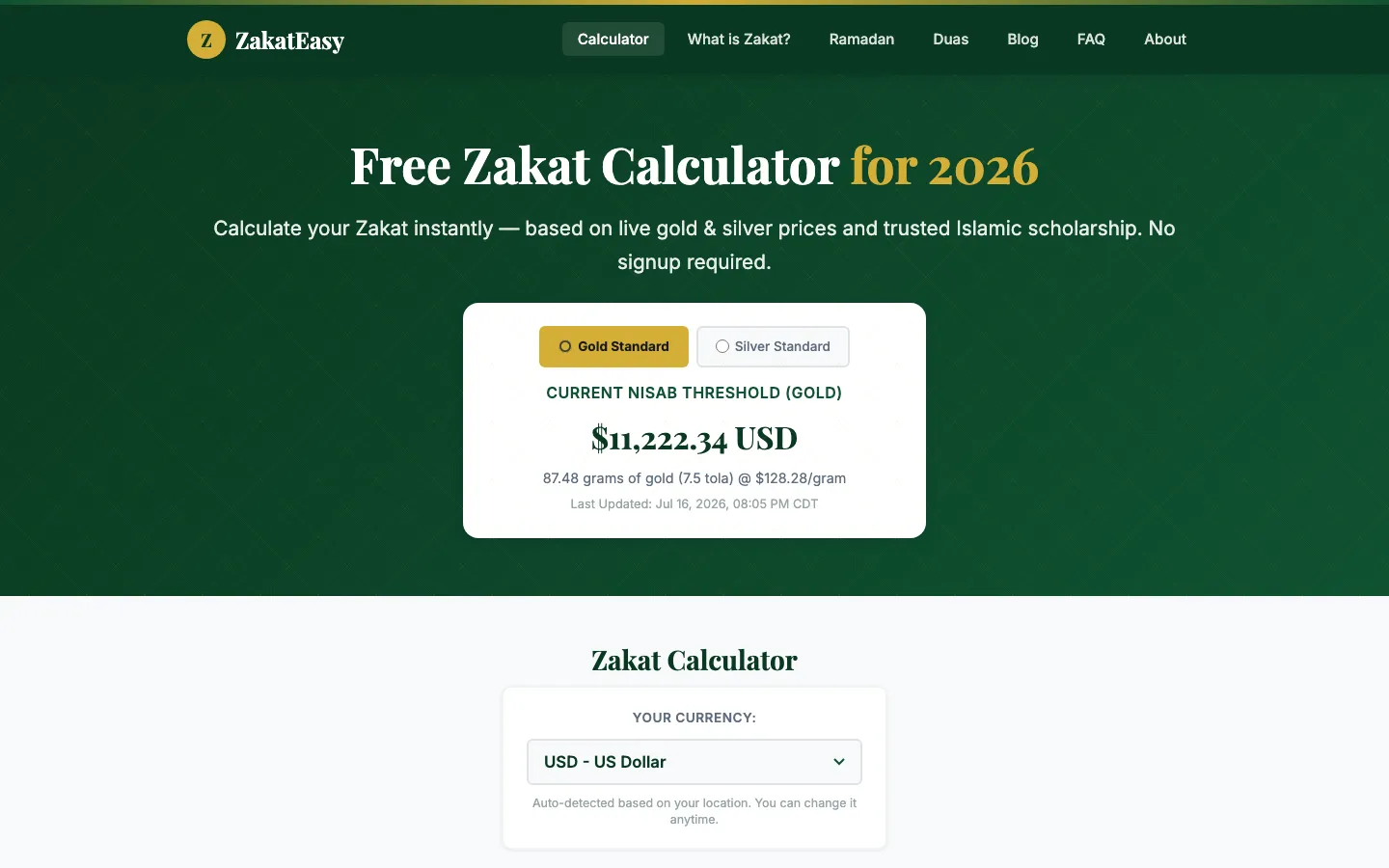
The calculator sits at the top of the page, not behind a sign-up. Everything below it exists to explain the number it produces.
A calculator people trust, because it shows its working.
Eight asset inputs — cash, cryptocurrency, gold, silver, investments, business assets, money owed to you, and other zakatable wealth
Two liability inputs deducted from the total, so the figure reflects what is actually owed
Gold and silver accepted in market value, grams or tola, because that is how people actually hold them
The current nisab threshold displayed on the page, so the result can be checked against it
Long-form guidance on nisab, zakatable wealth and calculation method, structured for search
A stated disclaimer directing complex cases to a qualified scholar
The number is easy. Trusting it is the hard part
Zakat is an obligation, and people are careful with obligations. A calculator that returns a figure without showing where it came from does not get used twice — the user checks it against something else, finds a discrepancy they cannot explain, and leaves.
That shaped the whole build. The calculator itself is at the top of the page and needs no account, no email and no sign-up. Everything below it exists to justify the output: how the calculation works, what the nisab threshold is and why it moves, which categories of wealth are zakatable, and a set of frequently asked questions covering the cases the form cannot. The tool answers the question; the page answers the question behind the question.
Ten inputs, because wealth is not just a bank balance
The assets section takes eight figures — cash and bank balances, cryptocurrency, gold, silver, investments and stocks, business assets, money owed to you, and a catch-all for other zakatable assets. The liabilities section takes two, immediate debts and unpaid bills, and subtracts them.
Each of those exists because leaving it out produces a wrong answer for a real group of people. Drop the crypto field and every younger user gets a figure that understates what they owe. Drop "money owed to you" and anyone self-employed is calculating on the wrong base. Drop the liabilities entirely — which plenty of calculators do, because it is simpler — and everyone overpays.
Gold and silver get particular attention: they can be entered as market value, in grams, or in tola. Most people do not know the market value of jewellery they inherited, but they very often know its weight. Asking for a number the user does not have is the fastest way to lose them mid-form.
Why the guidance is as long as it is
There is a real temptation to ship the calculator alone and keep the page clean. It would have been a worse product and a much worse-performing one.
Somebody working out their zakat is asking a question that has an answer, and they are asking it in a search engine: what is nisab this year, does crypto count, do I pay on my pension, what if I owe money. A calculator on its own can be found by people searching for a calculator. A calculator wrapped in genuine answers can be found by everyone asking any of the questions that lead to needing one — and those people arrive already needing the tool sitting at the top of the page.
The traffic is also intensely seasonal, concentrated around Ramadan. Content that ranks has to be in place well before the season rather than published into it, which is an argument for depth early rather than a thin page you intend to expand later.
Saying what the tool cannot do
The site carries a plain disclaimer: it is a calculation tool for informational purposes, and complex circumstances belong with a qualified scholar.
That line costs nothing and buys a great deal. Zakat has genuine edge cases — mixed business ownership, debt structured in particular ways, assets held on behalf of others — and a tool that implied it had settled them would be overreaching. Naming the boundary is what makes the rest of the page credible, and it is a pattern worth stealing for any calculator that touches money, law, or health.
Four things you can check on the live site right now.
- 1Open the calculator and note that it runs without an account, an email address, or a sign-up.
- 2Switch the gold input between market value, grams and tola.
- 3Check the nisab threshold shown on the page against the result the calculator returns.
- 4Scroll past the tool and read how far the guidance goes beyond the arithmetic.
Want a tool like this built for your organisation?
Book a free consultation. We'll show you what we'd build for you, and what it would take.