Triveni Balavikas Central School
A live site for a new ICSE school in Bengaluru, built to answer what a parent asks before they will book a visit — and to say the fees out loud.
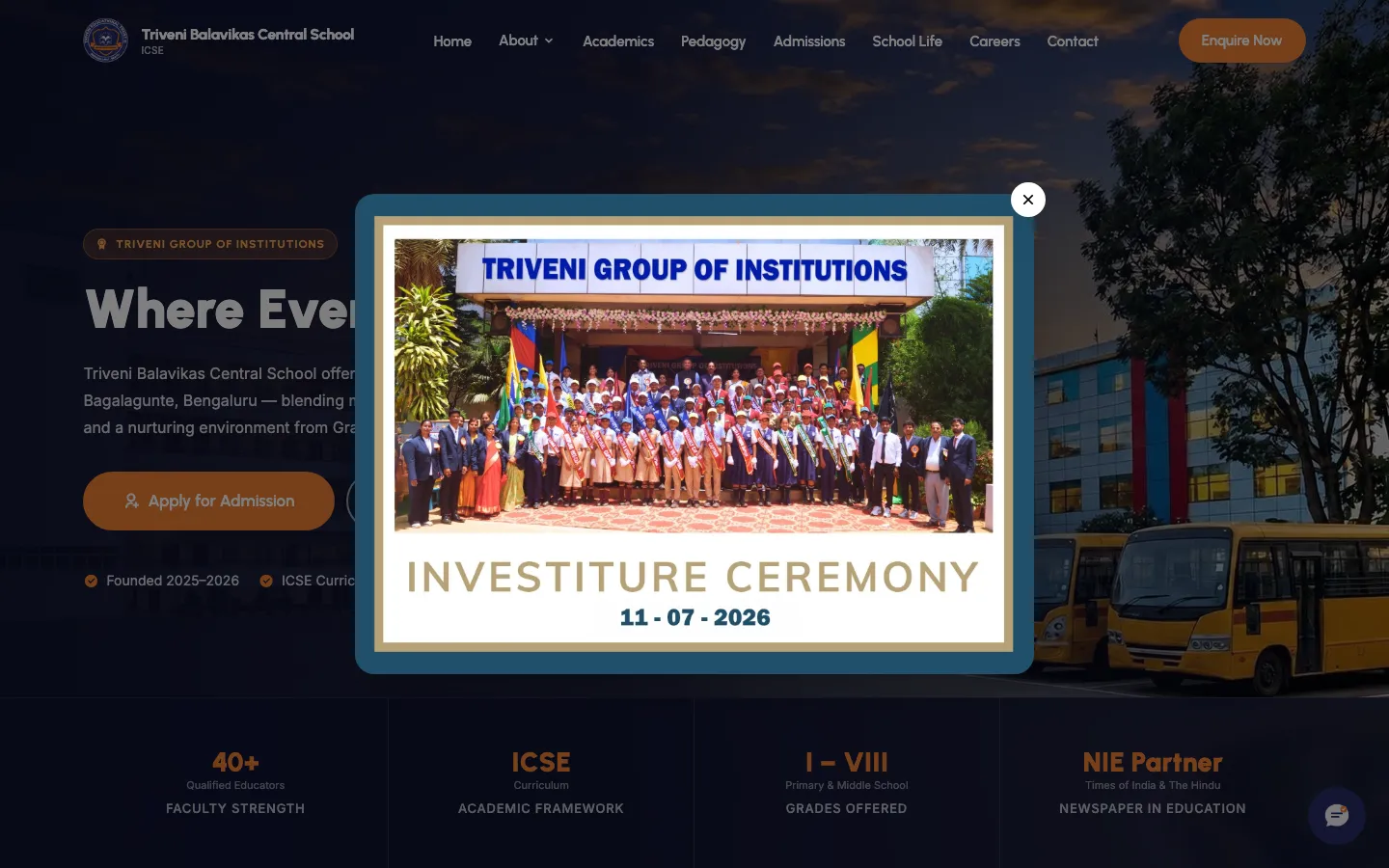
A school site has one visitor worth designing for — a parent comparing three schools at 11pm. Everything here is built for that reading.
Written for the parent comparing you against two other schools tonight.
Admissions for the 2026–2027 intake stated on the homepage with a direct enquiry route
Board and grade range — ICSE, classes I to VIII — established immediately, since that is the first filter parents apply
Fees addressed head-on rather than avoided, under "Premium Pedagogy at Affordable Fees"
A pedagogy section explaining how the school teaches, not just what it offers
An FAQ built from the questions parents actually ask, titled as such
Enquiry and admission calls to action repeated across every major section
One visitor matters more than all the others
A school website has plenty of audiences — current parents, staff, applicants for jobs, the board. Only one of them decides whether the school fills its seats: a parent, usually late in the evening, with three school websites open and a shortlist to cut down to one visit.
That parent is not reading. They are scanning for reasons to eliminate you. Which board? Which classes? Where exactly? Can we afford it? What do other parents say? If any of those answers takes more than a few seconds to find, the tab closes, and you never learn that it did. Every structural decision on this build follows from that reading.
Answer the filters before you make the pitch
Board and grade range come first, because they are disqualifiers. A family looking for CBSE is not a lost sale when they find out this is an ICSE school — they were never a sale, and the sooner both sides establish that, the less time everyone wastes. The same is true of the class range: classes I to VIII, stated plainly. A parent with a child entering class IX needs to know that immediately, not after reading the pedagogy section.
Only once those filters are cleared does the site start persuading. That ordering feels counterintuitive — it means opening with the facts most likely to lose a visitor — but the visitors it loses were never going to convert, and the ones who remain are reading everything that follows with genuine intent.
Say the thing about fees
Almost every school website avoids the subject of cost entirely, which every parent reads as expensive. This site takes it on directly, in a section headed "Premium Pedagogy at Affordable Fees".
That is a positioning statement rather than a price list, and for a school it is the right instrument — fee structures vary by class and change annually, so publishing a single number would be misleading within a year. But addressing the question at all puts the site ahead of nearly every competitor a parent will look at that evening, because it signals that the school is not uncomfortable talking about money. The parent still has to enquire to get the figure. They enquire believing the answer will be reasonable.
A new school has a harder job
Triveni opened for the 2025–2026 session. A school with a thirty-year history can rely on reputation doing the persuading; a new one has no alumni, no exam record and no word of mouth yet, so the website is carrying more weight than it would anywhere else.
The response was to be concrete about method rather than making claims about outcomes it is too early to have. The pedagogy section explains how children are actually taught. The school life section shows what a day looks like. Parent testimonials do the work reputation cannot yet do. And the FAQ is titled "Questions Parents Ask" — which sounds like a small thing and is not, because a page written in the parent's own words reads as a school that has listened to parents rather than one talking at them.
Worth noting on the delivery side: this site was built for a school in Bengaluru, from the United States, entirely remotely. If you are weighing an agency that is not down the road from you, that is the relevant precedent.
Four things you can check on the live site right now.
- 1Time how long it takes to establish the board and the class range. It should be seconds.
- 2Find the fees section and note that it addresses cost rather than avoiding it.
- 3Read the FAQ headings — they are phrased as parents ask them, not as the school would.
- 4Count how many sections offer an enquiry route without scrolling back to the top.
Want a site like this for your school?
Book a free consultation. We'll show you what we'd build for you, and what it would take.